
• Skip to main content
  • Skip to primary sidebar
  • Skip to footer
  • Home
  • About Darknet
  • Hacking Tools
  • Popular Posts
  • Darknet Archives
  • Contact Darknet
    • Advertise
    • Submit a Tool
Darknet – Hacking Tools, Hacker News & Cyber Security

Darknet - Hacking Tools, Hacker News & Cyber Security

Darknet is your best source for the latest hacking tools, hacker news, cyber security best practices, ethical hacking & pen-testing.

GKE Auditor – Detect Google Kubernetes Engine Misconfigurations

January 1, 2021

Views: 2,767

GKE Auditor is a Java-based tool to detect Google Kubernetes Engine misconfigurations, it aims to help security and development teams streamline the configuration process and save time looking for generic bugs and vulnerabilities.
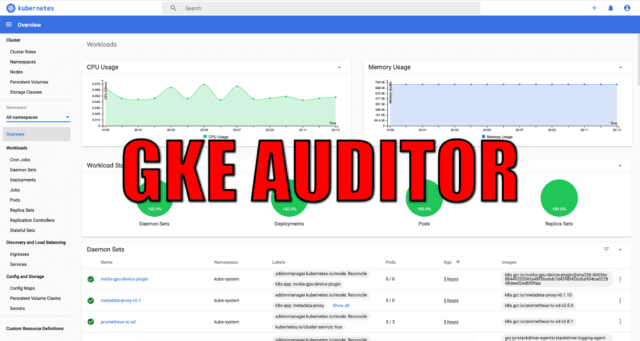
GKE Auditor - Detect Google Kubernetes Engine Misconfigurations

The tool consists of individual modules called Detectors, each scanning for a specific vulnerability.

Installing and Using GKE Auditor to Detect Google Kubernetes Engine Misconfigurations

Installation

1
2
3
git clone https://github.com/google/gke-auditor
cd ./gke-auditor/
./build.sh

Usage

The tool has to be built by running the build.sh script first.

Once the tool is built, it can be run using the auditor.sh script, using the following options:

1
2
3
4
5
6
7
8
9
10
11
12
13
14
15
16
17
18
19
20
21
22
23
24
25
26
27
28
29
30
31
32
33
34
35
36
37
38
39
40
./auditor.sh [-a] [-ast] [-c] [-d] [-h] [-i <arg>] [-p <arg>] [-q]
       [-r <arg>]
-a,--all          Run all detectors.
-ast,--assets     Run all detectors for each individual asset.
-c,--color        Turns on tool output coloring.
-d,--defaults     Runs detectors including Kubernetes default assets.
                   Disabled by default.
-h,--help         Print help information.
-i,--iso <arg>    Run Node Isolation detectors.
                   To run all detectors, omit the argument list.
                   To specify individual detectors to run, give a list of
                   indices:
                   1. NODE_SELECTOR_POD_REJECTED
                   2. NODE_TAINTS_POD_REJECTED
                   3. NODE_AFFINITY_POD_REJECTED
-p,--psp <arg>    Run PSP (Pod Security Policy) detectors.
                   To run all detectors, omit the argument list.
                   To specify individual detectors to run, give a list of
                   indices:
                   1. PRIVILEGED_CONTAINERS
                   2. CONTAINERS_SHARING_HOST_PROCESS_ID_NAMESPACE
                   3. CONTAINERS_SHARING_HOST_IPC
                   4. CONTAINER_SHARING_HOST_NETWORK_NAMESPACE
                   5. CONTAINERS_ALLOW_PRIVILEGE_ESCALATION
                   6. ROOT_CONTAINERS_ADMISSION
                   7. CONTAINERS_NET_RAW_CAPABILITY
                   8. CONTAINERS_ADDED_CAPABILITIES
                   9. CONTAINERS_CAPABILITIES_ASSIGNED
-q,--quiet        Prints out only misconfigurations, without additional
                   detector info. Disabled by default.
-r,--rbac <arg>   Run RBAC (Role Based Access Control) detectors.
                   To run all detectors, omit the argument list.
                   To specify individual detectors to run, give a list of
                   indices:
                   1. CLUSTER_ADMIN_ROLE_USED
                   2. SECRET_ACCESS_ALLOWED
                   3. WILDCARD_USED
                   4. CREATE_PODS_ALLOWED
                   5. AUTOMOUNT_SERVICE_ACCOUNT_TOKEN_ENABLED
                   6. ESCALATING_RESOURCES_REPORT

General Detector Output Format for GKE Auditor

  • Detector: Detector name
  • Explanation: A short explanation of the concept that is being checked. Describes how and why the concept be a security issue. Often includes links to the documentation for more information.
  • Remediation: Steps to take in order to review the problem and resolve the vulnerability.
  • Useful links: Links to the documentation or other resources where the customer can learn about the issues at hand.
  • Level: one of [VULNERABILITY, WARNING]. VULNERABILITY implies security recommendations are not being followed, whereas a WARNING is informational and implies a potential vulnerability could exist.
  • Severity: one of [LOW, MEDIUM, HIGH]. Indicator of the seriousness of detected issues.
  • Vulnerable assets: List of assets that have the above-described vulnerability.
  • You can download GKE Auditor here:

    gke-auditor-master.zip

    Or read more here.

    Related Posts:

    • An Introduction To Web Application Security Systems
    • NetExec - Network Execution Toolkit for Windows and…
    • RustRedOps - Rust Native Offensive Toolkit…
    • XRayC2 - Weaponizing AWS X-Ray for Covert Command…
    • AIPentestKit - AI-Augmented Red Team Toolkit for…
    • testssl.sh - Test SSL Security Including Ciphers,…
    Share
    Tweet
    Share
    Buffer
    WhatsApp
    Email

    Filed Under: Countermeasures


    Primary Sidebar

    Search Darknet

    • Email
    • Facebook
    • LinkedIn
    • RSS
    • Twitter

    Advertise on Darknet

    Latest Posts

    Initial Access Brokers (IAB) in 2025 - From Dark Web Listings to Supply Chain Ransomware Events

    Initial Access Brokers (IAB) in 2025 – From Dark Web Listings to Supply Chain Ransomware Events

    Views: 4

    Initial Access Brokers (IABs) have moved from niche forum actors to central wholesalers in the … ...More about Initial Access Brokers (IAB) in 2025 – From Dark Web Listings to Supply Chain Ransomware Events

    Reconnoitre - Open-Source Reconnaissance and Service Enumeration Tool

    Reconnoitre – Open-Source Reconnaissance and Service Enumeration Tool

    Views: 335

    Reconnoitre is an open-source reconnaissance tool that automates multithreaded information gathering … ...More about Reconnoitre – Open-Source Reconnaissance and Service Enumeration Tool

    Scanners-Box - Open-Source Reconnaissance and Scanning Toolkit

    Scanners-Box – Open-Source Reconnaissance and Scanning Toolkit

    Views: 505

    Scanners-Box is an open-source, community-curated collection of scanners and reconnaissance … ...More about Scanners-Box – Open-Source Reconnaissance and Scanning Toolkit

    Red Teaming LLMs 2025 - Offensive Security Meets Generative AI

    Red Teaming LLMs 2025 – Offensive Security Meets Generative AI

    Views: 539

    As enterprises deploy large language models (LLMs) at scale, the offensive security discipline of … ...More about Red Teaming LLMs 2025 – Offensive Security Meets Generative AI

    gitlab-runner-research - PoC for abusing self-hosted GitLab runners

    gitlab-runner-research – PoC for abusing self-hosted GitLab runners

    Views: 351

    gitlab-runner-research is a proof-of-concept repository and write-up that demonstrates how attackers … ...More about gitlab-runner-research – PoC for abusing self-hosted GitLab runners

    mcp-scanner - Python MCP Scanner for Prompt-Injection and Insecure Agents

    mcp-scanner – Python MCP Scanner for Prompt-Injection and Insecure Agents

    Views: 602

    mcp-scanner is an open-source Python tool that scans Model Context Protocol (MCP) servers and agent … ...More about mcp-scanner – Python MCP Scanner for Prompt-Injection and Insecure Agents

    Topics

    • Advertorial (28)
    • Apple (46)
    • Cloud Security (8)
    • Countermeasures (231)
    • Cryptography (85)
    • Dark Web (5)
    • Database Hacking (89)
    • Events/Cons (7)
    • Exploits/Vulnerabilities (433)
    • Forensics (64)
    • GenAI (12)
    • Hacker Culture (10)
    • Hacking News (236)
    • Hacking Tools (708)
    • Hardware Hacking (82)
    • Legal Issues (179)
    • Linux Hacking (74)
    • Malware (241)
    • Networking Hacking Tools (352)
    • Password Cracking Tools (107)
    • Phishing (41)
    • Privacy (219)
    • Secure Coding (119)
    • Security Software (235)
    • Site News (51)
      • Authors (6)
    • Social Engineering (37)
    • Spammers & Scammers (76)
    • Stupid E-mails (6)
    • Telecomms Hacking (6)
    • UNIX Hacking (6)
    • Virology (6)
    • Web Hacking (384)
    • Windows Hacking (171)
    • Wireless Hacking (45)

    Security Blogs

    • Dancho Danchev
    • F-Secure Weblog
    • Google Online Security
    • Graham Cluley
    • Internet Storm Center
    • Krebs on Security
    • Schneier on Security
    • TaoSecurity
    • Troy Hunt

    Security Links

    • Exploits Database
    • Linux Security
    • Register – Security
    • SANS
    • Sec Lists
    • US CERT

    Footer

    Most Viewed Posts

    • Brutus Password Cracker Hacker – Download brutus-aet2.zip AET2 (2,395,370)
    • Darknet – Hacking Tools, Hacker News & Cyber Security (2,173,817)
    • Top 15 Security Utilities & Download Hacking Tools (2,097,298)
    • 10 Best Security Live CD Distros (Pen-Test, Forensics & Recovery) (1,200,145)
    • Password List Download Best Word List – Most Common Passwords (934,352)
    • wwwhack 1.9 – wwwhack19.zip Web Hacking Software Free Download (777,071)
    • Hack Tools/Exploits (673,988)
    • Wep0ff – Wireless WEP Key Cracker Tool (531,060)

    Search

    Recent Posts

    • Initial Access Brokers (IAB) in 2025 – From Dark Web Listings to Supply Chain Ransomware Events November 12, 2025
    • Reconnoitre – Open-Source Reconnaissance and Service Enumeration Tool November 10, 2025
    • Scanners-Box – Open-Source Reconnaissance and Scanning Toolkit November 7, 2025
    • Red Teaming LLMs 2025 – Offensive Security Meets Generative AI November 5, 2025
    • gitlab-runner-research – PoC for abusing self-hosted GitLab runners November 3, 2025
    • mcp-scanner – Python MCP Scanner for Prompt-Injection and Insecure Agents October 31, 2025

    Tags

    apple botnets computer-security darknet Database Hacking ddos dos exploits fuzzing google hacking-networks hacking-websites hacking-windows hacking tool Information-Security information gathering Legal Issues malware microsoft network-security Network Hacking Password Cracking pen-testing penetration-testing Phishing Privacy Python scammers Security Security Software spam spammers sql-injection trojan trojans virus viruses vulnerabilities web-application-security web-security windows windows-security Windows Hacking worms XSS

    Copyright © 1999–2025 Darknet All Rights Reserved · Privacy Policy